Monday, January 16, 2017

31 December 2016 - Antarctica, Deception Island.

Noon position : 62* 55’S 60* 40’W Sea temperature 2.4C Air temperature 2.1C

The first stop today on Deception Island was at Telephon Bay. Deception Island was given the name because the island was first though to be a normal island but deceptively it has an entrance, called Neptune's Bellows, into the centre of the island and a to one of the safest harbours in the Antarctic. Care has to be taken entering through the ‘Bellows’, which is 120 metres wide, as below the surface there is a rock which seriously restricts the usable width of the entrance.

Map of Deception Island showing the entrance
 This island is the caldera of an active volcano which seriously damaged local scientific stations in 1967 and 1969. The island previously held a whaling station; it is now a tourist destination and scientific outpost, with Argentine and Spanish research bases. While various countries have asserted sovereignty, it is still administered under the Antarctic Treaty System.

In 1904, an active whaling industry was established at South Georgia, taking advantage of new technology and an almost untouched population of whales to make rapid profits. It spread south into the South Shetland Islands, where the lack of shore-based infrastructure meant that the whales had to be towed to moored factory ships for processing; these needed a sheltered anchorage and a plentiful supply of fresh water, both of which could be found at Deception. In 1906 Whalers Bay began as a base for a single ship.

Other whalers followed, with several hundred men resident at Deception during the Antarctic summers and as many as thirteen ships operating in peak years. In 1908, the British government formally declared the island to be part of the Falkland Islands Dependencies and thus under British control, establishing postal services as well as appointing a magistrate and customs officer for the island. The magistrate would ensure that whaling companies were paying appropriate licence fees to the Falklands government as well as ensuring that catch quotas were adhered to. A cemetery was built in 1908, a radio station in 1912, a hand operated railway also in 1912, and a small permanent magistrate's house in 1914. The cemetery, by far the largest in Antarctica, held graves for 35 men along with a memorial to 10 more presumed drowned. These were not the only constructions; as the factory ships of the period were only able to strip the blubber from whales and could not use the carcasses, a permanent on-shore station was established by the Norwegians in 1912 – it was estimated that up to 40% of the available oil was being wasted by the ship-based system. This was the only successful shore-based industry ever to operate in Antarctica, reaping high profits in its first years. In 1928 a Lockheed Vega plane was flown from a beach airstrip on the first successful flights in Antarctica.

The development of pelagic whaling in the 1920's, where factory ships fitted with a slipway could tow aboard entire whales for processing, meant that whaling companies were no longer tied to sheltered anchorages. A boom in pelagic Antarctic whaling followed, with companies now free to ignore quotas and escape the costs of licences. This rapidly led to overproduction of oil and a collapse in the market, and the less profitable and more heavily regulated shore-based companies had trouble competing. In early 1931 the Norwegian factory finally ceased operation, ending commercial whaling at the island entirely.

Telephon Bay had fantastic colours of black (the result of volcanic eruptions) and the white of the snow with every shade of grey in-between. The walk over the top of the hills was not too arduous and was helped by the sunny day.

Views of Telephon Bay

DSCN0191_thumb


DSCN0170_thumb

P1060170_thumb
Add caption
DSCN0176_thumb

DSCN0184_thumb

P1060164_thumb1

DSCN0187_thumb

In the afternoon we went into Pendulum Cove, still in Deception Island, to swim in the heated sea water. Some volcanic action heated the black sand/gravel so that the water on the edge of the beach was heated, some to an unbearably hot temperature. New years Eve swimming in the Antarctic, never would I have expected that!

Views of Pendulum Cove


A Chilean meteorological and volcanological research station in Pendulum Cove, opened in February 1955. It was destroyed by volcanic eruptions in 1967 and 1969.

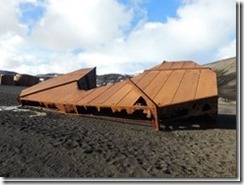
Early on in the evening a visit to Whalers Bay was organised (possibly to get us all of the ship so that the crew could prepare for the New Years party) to see the remains of the old whaling station which had burnt down in 1967  There were the remains of buildings (from 1906 to 1912)  and whale bones together with boilers and cooking vessels for the process of whale blubber. It must have been a hard existence down here during the whaling seasons
.
A painting of a blue whale being flensed at Whalers Bay. Flensing  is the  removing of the blubber or outer fat of the whale, the remaining parts being throw away as it took too much effort to remove the rest of the blubber when whales were in abundance.

DSCN0247_thumb
Remaining buildings
DSCN0243_thumb
Steam boilers (very much like on some of the ships I sailed on)
DSCN0246_thumb
Oil tanks
DSCN0248_thumb
The remains of the graveyard
P1060199_thumb
Oil tanks and boilers
DSCN0237_thumb
Part of an old floating dock


To one end of the area were some jagged high rocks used by various birds for nesting and one leopard seal. This area looked and smelt of sulphur.
DSCN0228_thumb
Bird nesting areas
DSCN0225_thumb


DSCN0165_thumb
Leopard seals 
DSCN0224_thumb

DSCN0231_thumb


The ship had been decorated (dressed overall) while we were ashore and a large quantity of food was available to celebrate thee New Year. It was strange to do so while it was still light. The pictures below are of the party with the obligatory smoking barbecue.

P1060206_thumb

P1060211_thumb

P1060212_thumb

P1060210_thumb


30 December, 2016 - Antarctica, Greenwich Island.

Anchoring at 0900 hrs on a calm sea, we were soon ashore at Fort Point on Greenwich Island which is a rocky point rising to 85 metres on the southeast coast of South Shetland Islandsa place we were told was rarely visited by anyone. There were lots of penguins here (Gentoo and chinstrap) and it was a joy to watch them and then having them seemingly watch us. They did not seem to be bothered by the invasion of the tourists (not even the ones with young) but looked as if they were curious about us and looked as if they posed for photographs to be taken.


Map of the South Shetland Islands
 .
Various views at Fort Point

DSC02925

DSCN0004

DSCN0018

P1060108

P1060078

P1060097

P1060095

     
Later that afternoon we went ashore at Yankee Harbour, also on Greenwich Island where there were young elephant seals and penguins. Yankee Harbour was known to both American and British sealers as early as 1820,

Various views at Yankee Harbour


DSC02939

DSC02936

DSCN0098

P1060147

P1060148

P1060117

DSC02940

     
After dinner we were to go ashore again but as whales had been sighted Mateos went out in the boat to try and take samples from them and photograph them in an attempt to eventually identify them individually. He used a crossbow with a modified arrow, which, when shot into the whale took a small sample of the whale skin, this will later be examined to determine various things.

Saturday, January 14, 2017

28 and 29 December 2017 – Antarctica, King George Island

28 December

Noon position : 60*18'S 61*05'W Sea temperature - 2.0 C Air temperature - 1.8C

The sea was not too rough today with the ship being in the Convergence Zone but we did have a permanent starboard list so putting on two trousers was hard with all of the movement going on. For those who’s bunk is next to the hull they were told that there was a camping ground sheet under the mattress which they could pull out and shield themselves from the damp hull as there was a lot of condensation around. Even during the night it is not dark now with plenty of light to see when walking about the ship. The outside temperature is 1 degrees C. We are still using more water than the ship is making. Fresh bread is made every day and dry crackers are left out most of the time for those who are under the weather and not eating properly.

The Antarctic Convergence Zone is the odd ocean zone encircling the continent where the warmer water from the northern oceans run into the colder water from the Southern Ocean. The cold water flows under the warmer water bringing up nutrients into the Southern Ocean and the joining of both currents can cause rough seas.

Early morning and the ship was moving easily. It was not particularly cold, then being told it was actually 1 degrees C, and 30 minutes on steering or on lookout was enough at one time, especially for the fingers, gloves or no. Everything put on the cabin floor slides all over the place so when we get up the first job is to untangle the mess of boots and clothes. I’ve figured out how to stop my boots going everywhere and that is to put the laces into an open drawer and the close the drawer trapping the laces and stopping the boots from moving. I put my glasses in the boots for safe keeping as well.

Noon to noon travel today was 128 miles and the skipper said that we had 110 miles to go to our first landing, which everyone is looking forward to happening. Just after noon a fire drill was called, the fire being in the laundry space.

Later we were given a talk about what is expected of us when landing in the Antarctic. This is in accordance with the Code of Conduct for Visitors to Antarctica and South Georgia agreed by the Georgia International Association of Antarctic Tourist Operators. The Antarctic is the largest wilderness on earth and need protection after the desecration done there by others in the past. The rules relate to no littering, no taking plastic bags ashore, no smoking, no eating, no toilets, for a few. Do not pick up feathers, stones, bones, bird shell, artefacts do not go into buildings or damage any building or item: Watch where we step, not in animal pathways, on lichen, moss or grass. Keep away from animals by defined distances, walk and talk slowly near them and give them precedence when walking around. A suggestion was also to wear as little as possible about the ears so as to be able to listen to the animal sounds which could be indicative of anger. Watch out for diving birds. Do not have snow ball fights. Very specifically beware of animals being around when taking photos and not watching what is going on around you. Try to photograph or record any tag  number that you see and advise the ships staff of any. No alcohol is to be drunk two hours before going ashore. Before leaving the ship check your name is ticked off on a list indicating those going ashore and when returning and wear a lifebelt. Step into disinfectant before leaving and returning to the ship and and also disinfect any tripods and walking sticks.

Access to the Antarctic region can only allowed with the permission of the Dutch Government in this case as the ship is registered in Holland.

We had a talk from the marine biologist who will be leaving the ship tomorrow for a six weeks stay at Maxwell Bay, King George Island while he works as a diver checking the algae and molluscs with a view to keeping an eye on the effect on them due to climate change. The research is to go on for five years, and if productive, for a further ten years.

While keeping watch this evening we were told to watch out for whales and icebergs as we are in the area where they can be expected to be seen. Just noticed that my Santiago/Easter Island suntan has nearly disappeared!

29 December

Noon position : 62*17'S 58*44'W Sea temperature - 2.0 C Air temperature - 0.1C

There were calm seas this morning while we sailed into Maxwell Bay at King George Island, sighting our first large iceberg on the way. To increase the excitement of landing for the first time today we had bacon and egg for breakfast! Maxwell Bay is the home to a number of research stations, Chilean, Argentinian, Russian and Chinese to name a few. There was even a Russian Orthodox Church there and the only airstrip in this area, but not the only one in Antarctica.

P1060031_thumb
Russian Orthodox Church
P1060036_thumb
Sign at the air strip
DSCN0385_thumb
The Europa in the bay
Chinstrap penguins
Getting ashore
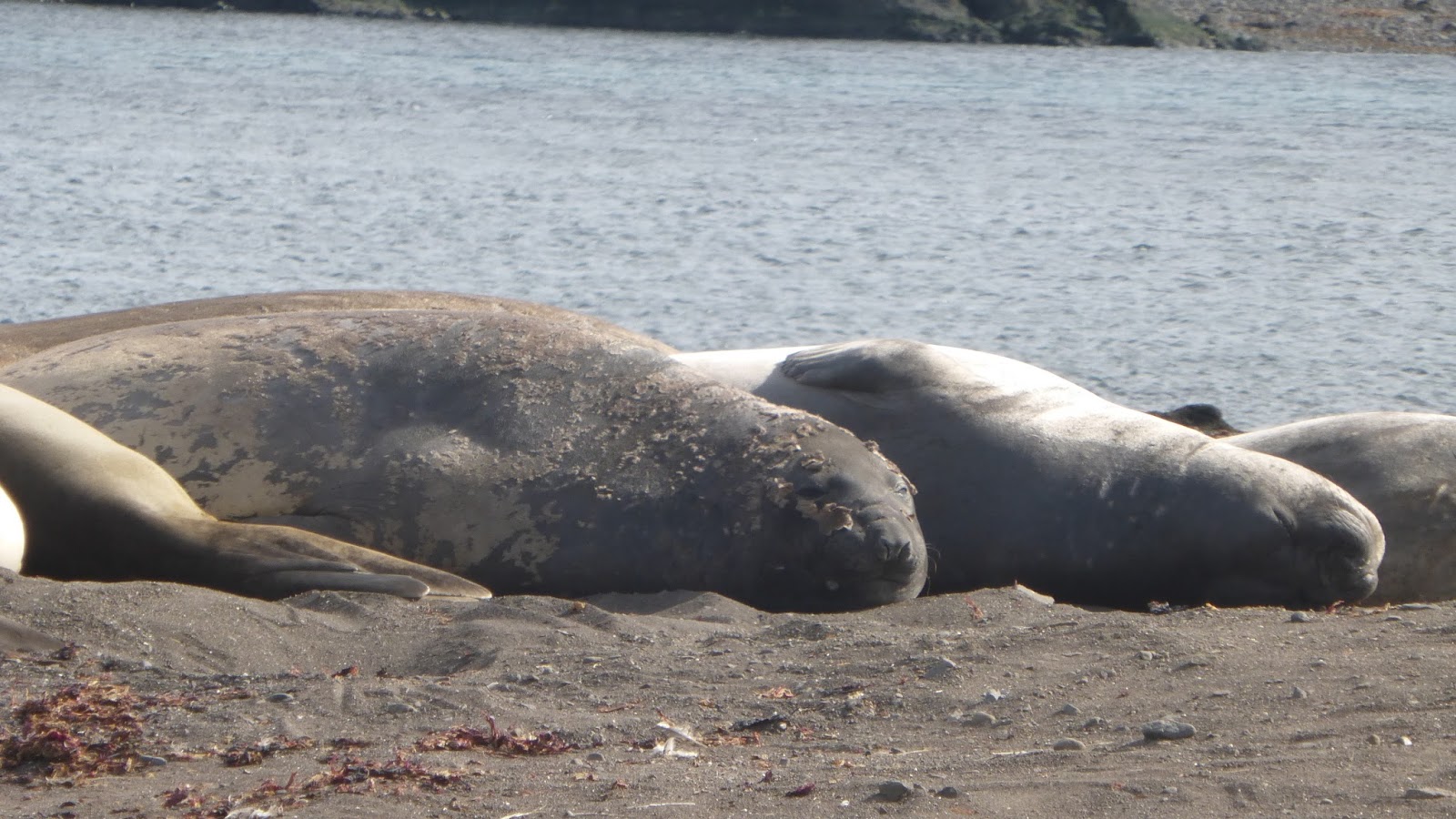
Happy seal
Very happy seals

DSC02921_thumb
The other side over the bay


26 and 27 December 201 – To Antarctica

26 December

Noon position : 58* 24’S 62* 49’W Sea temperature - 7.6C Air temperature - 2.4C

The main engines were stopped at 0530 hrs, blessed quiet! Our cabin has a porthole (which cannot be opened) which is often under water. When I was in the Merchant Navy I was often asked if it was boring in the engine room and I answered that to pass the time I would watch the fish going past through the porthole in the hull. Many believed this! Now it looks as if the person lying in the bunk near the porthole could actually watch the fish going by especially as the ship is rolling and pitching quite well.

When keeping watch now I am wearing two trousers (one waterproof), shirt, sweater, coat, plastic undercoat, waterproof coat, about four bits of headgear and two pairs of thermal socks. The hardest part of wearing this amount of clothing is the dressing when the ship is moving all over the place. If that is not the hardest thing to do then it is getting out of the bunk as there is a very high wooden sill to keep us in the bunks, hard to get over. We were told not to walk around in stocking feet as they slide very well on the floors. Having a shower with the ship moving is something of an exercise as well, I figured out that sitting on the toilet and taking the shower head out of the holder was the safer way and the comments from other who tried to shower without sitting down is something to believe.

DSCN0692_thumb
The ship's log
DSCN0688_thumb
The ship's log
The log shows a very tidy pencil outline of the ship. When I looked closer I found that it was a sticker with a print of the ship which is then filled in to show what sails were in use during a period of time (usually the length of a normal watch)

When out on deck today we had to wear a harness at all times, and keep it clipped on to the safety lines. Later on the window guards were fitted over the deck house windows, as the ship was rolling so bad and shipping water over the deck house. Access across the aft deck was stopped with all movement being made through the below deck passages. Someone had six different types of sea sick remedies, nothing like being prepared!

P1050982_thumb[1]
Safely hooked on while a lookout at the bows.
P1050970_thumb[1]
The ship rolling to port
P1050978_thumb[1]
The ship rolling to starboard
P1060007_thumb[1]
Steering

The passengers used more fresh water than the engine room made over the last 24 hours. Our speed has been between 5.5 and 9 knots depending on the wind.

27 December

Noon position : 58* 26’S 62* 49’W Sea temperature - 7.6C Air temperature - 2.4C
        
The sea was very rough during the night and I had little sleep. During the morning 4 to 8 watch the sea was too rough for lookouts to stay on the forecastle so they stood at the wheel house and harnesses still had to be worn on deck. After changing sails the speed increased to 10.5 knots, very good for this ship so it seemed. People who had been seasick over the past days now started to appear with the weather improving later in the day, including blue seas.

No-matter the weather the kitchen crew produced meals on time, good wholesome meals at that. The evening meals have consisted of rice, mashed potatoes or pasta with a meat sauce, vegetarian options being available as well. Most of the time a tin of dry biscuits are kept in the deck house for anyone to eat. During the midnight to 4 watch soup and bread is available in the deck house for those on watch.The tables have a clingy sort of thick plastic sheet on them to stop the crockery from moving except in extreme movement of the ship.

The ship travelled 170 miles noon to noon today (that is the straight line figure and does not count the zig-zag course travelled depending on the wind) and the outside temperature is 3.5C. Now that the ship is listing to starboard I have had to turn round in my bunk so that my head is at the highest point. A sailing ship always has a list depending on the way the wind is blowing and how the sails are rigged.

As a requirement for going ashore at Antarctica we all had to vacuum clean our day bags, shoes and outside clothing, taking special care with the pockets. This was so ass not to take any foreign items, dirt or seeds onto the Antarctic continent.


24 and 25 December 2016 – To Antarctica

I joined the ship at 1700 hrs as advised to find that I was just about the last person to arrive. In total there were 43 passengers (of twelve nationalities) and 18 crew (of four nationalities) making a total of 61 souls on board. On arrival I was taken to my cabin where I had been allocated a bottom bunk (thank goodness, as I doubt that I would have been able to climb in and out of a top bunk) in a six bunk cabin though there were only five of us in the cabin. This was actually very handy as the unused bunk was used to store bags and less used items as the storage space in the cabin was sadly lacking. My cabin mates were one Irish, two Germans and one Swede. Pillows, sheets, duvets and towels were supplied and each cabin had it’s own shower and toilet, the shower we were told having a heated floor.
 
The Europa was built in Germany in 1911 and served as a lightship at the mouth of the River Elbe. She had no engine and survived two world wars, then in the seventies over an eight year period was converted into the bark Europa. She is Dutch flagged and has all the necessary safety equipment, two main engines, one generating set, bow thruster and motorised anchor winch. The main power for sailing is the wind.

Once settled in we were mustered on the main deck, welcomed, and had a toast (snapps I think) to wish the voyage well. Then we were told the rules of the ship, possibly the more important one being that although there was alcohol on board it was not to be consumed before going on watch. Dinner was then eaten consisting of chicken, mashed potatoes and salad. Then followed a further talk about not throwing anything overboard, how the different ship’s rubbish was collected and stored until it could be sent ashore on our return to Ushuaia, the use of fresh water and the watch system that would be put in place for the passengers. The ship makes a certain amount of fresh water from sea water and although there was no mention of a restricted use it was hoped that the passengers would not use too much, especially in having showers.

P1060176
The Europa
Later we were given a talk about what was expected of us as visitors to Antarctica such as not throwing anything at all overboard and then had to sign that we had all understood what we had been told. We remained alongside the wharf during the night.
 
 
P1060008
Captain Klass Gastra
P1050955
Passengers on deck for a briefing
DSCN0372 - Copy
Our cabin, tidy compared to others.
   
DSCN0371_thumb1
Cabin toilet and shower, wet room type.
P1060010
Passengers information meeting in the deck house
 
                                                                                                                                Photographs of the passengers and crew had been taken yesterday and these were put up on the noticeboard together with which people would be in the three watches. The watches were normal for ships, four hours on watch then eight hours off watch, the watches being midnight to 0400 hrs, 0400 hrs to 0800 hrs then 0800 hrs to midday, the watches then repeating themselves. Although we were asked to join in and help the crew run the ship this was only a request but which all the passengers tried to do until they were cut down with sea sickness.

Breakfast at 0700 hrs consisted of various cereals, freshly baked breads, boiled eggs, yogurt, cold meats, fruit, juices, tea and coffee; plenty for everyone. After breakfast we had a safety talk, how to act when the various number bells were rung, fire alarms, man overboard, abandon ship procedures and what was expected of us when on watch and steering or doing lookout duty.

P1050952_thumb_thumb_thumb
Cold water immersion suit
With 42 passengers it meant that there could be 14 on each watch and generally this meant that two people each did steering or lookout for 30 minutes at a time, which was enough in the cold weather.

Lunch at 1300 hrs was a hot soup (sometime two different soups), cold meats, specially made pies, cheese and breads.

P1060013_thumb
Climbing the mast (not me)
During the day safety lines were rigged ready for the expected bad weather in the Drake Passage and those who wanted were allowed to climb the rigging. All of us were shown how to put on and use the safety harness which was expected to be necessary during the voyage, not just for climbing up to the rigging.
DSC02915_thumb
Climbing the mast (not me)

 
We initially moved off the wharf to a refuelling station at 0900 hrs on 25 December and did finally set sail through the Beagle Channel at 1730 hrs, the sails being helped by the main engines. I was on the 2000 to 2400 hrs watch when it never actually became dark and albatrosses, petrels and skuas could be seen flying around the ship. I believe we entered Drakes Passage about 2300 hrs, both under sail and engine power.
                                                    
This has been Christmas Day, but few people noticed!


24 December 2016 – Our route


I do not know how much of the map will be seen but this was the route taken by the Bark Europa from and to Ushuaia, obviously added by me after the voyage and not on the date above.
.
image

Saturday, December 24, 2016

24 December 2016 - Ushuaia (Argentina)

I join the Europa this afternoon for a 22 day voyage to Antarctica and return to Ushuaia. Let there be fair winds and calm seas.

DSCN0358
The Europa alongside at Ushuaia
SV Europa barque 2007-07.jpg
What she looks like at sea
What I am hoping to see